10 Anxious Fluctuations in Space-Time
I didn’t know what it was for the longest time; I thought that’s just how things are. Besides, “anxiety” was something that other people had, something that was diagnosed, something that was medicated. How could I have anxiety?
Well, I started to recognize patterns when my stomach churns, or my palms sweat, or my heart pounds. These responses coalesce into something more than “nervousness” or “fear” when coupled with a sense of dread. When anxiety strikes, I’m often not so much concerned with what’s happening right now as with what might happen in a bit.
Surprisingly, it feels empowering to put a name to this phenomenon, like how Harry Potter insists on calling Voldemort by name instead of You-Know-Who. In calling out my anxiety for what it is, rather than something like insecurity or weakness, I’m able to erase its elusiveness. The following passage from Anxiety: A Philosophical Guide, by Samir Chopra, stands out to me because it describes something otherwise hard to put into words:
Sometimes, psychiatric medication might be needed to make working with anxiety tractable… I have yet to hear of anyone, though, who says that medication cured them of their anxiety, though it did make it more bearable, making them “functional” even if not “high achieving.” An anxiety medication is “effective” if those taking it are not incapacitated and can perform those essential tasks– personal or professional– that require their attention and work… This very functionality of the medicated breeds suspicion, of course, that anxiety medications and their overprescription are part of a “get back to work” ideology unsympathetic to the genuine existentialist crisis of the worker, the parent, the child, the young adult striving to find their way forward in a confusing and disorienting world.
I’m not at all making an argument against medication or pharmaceuticals, nor am I denying the debilitating consequences of anxiety. My observation instead is that anxiety doesn’t seem to be something that can be cured, like a bacterial infection or broken bone, because anxiety isn’t an over-reactive amygdala, or an unresolved defensive mechanism of the unconscious. Anxiety is a field.
A field? Like a plot of grass that people play sports on? I’m borrowing a term from quantum field theory here. The standard model of physics, a heavily experimentally-validated achievement of modern science, describes reality as an arrangement of “fields,” mathematical grids of variable parameters that cover all space in the universe simultaneously and endlessly.
They’re like the ingredients that comprise the recipes of existence. Fluctuations in the values of these fields give rise to the physical particles that we observe, like protons and electrons, just as ratios of different ingredients yield different dishes. Particles flicker in and out of momentary existence as values in these fields fluctuate wildly; yet at scale, consistent patterns emerge that we observe as reality.
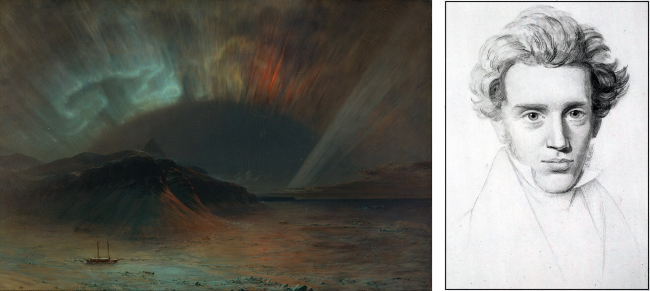
Imagine if each color arose from the activity of a field for that color. Particular patterns could lead to things like the aurora borealis (northern lights), painted here by Frederic Church (left). The philosopher Søren Kierkegaard (1813-1855; right) wrote much about anxiety that is still relevant today, demonstrating its common impact.
In saying that anxiety is a field, I mean that it’s one of the ingredients that our mind uses in its recipe for consciousness. We wouldn’t be able to be here without it. Anxiety is what keeps us alert when we hear a bump in the night, or what pushes us to crunch for that exam. We would be far more apathetic and far less engaged if anxiety were vanquished forever. (I know some would still prefer this.)
When my muscles tremble or my gut seizes up, I can better recognize that I might be caught too deep in the single field of anxiety. Bouncing back is not always as simple as going outside or watching your favorite movies, because the mischievous anxiety steals the enjoyment of those things from you. Restoring the symphony of the mind will differ for everyone, across every situation.
It’s a good thing, then, that space and time are so vast, with so many fields to explore, that the path to find the right balance can bring new discoveries with it. Yeah, there’s no map or directions, but why should that stop us? The next time anxiety strikes, I’ll take it as a chance to ride the fluctuations once more.